The yearning to belong arguably begins at birth for humans, but how can we all make progress on that need? An enormous new study with college students suggests a partial answer.
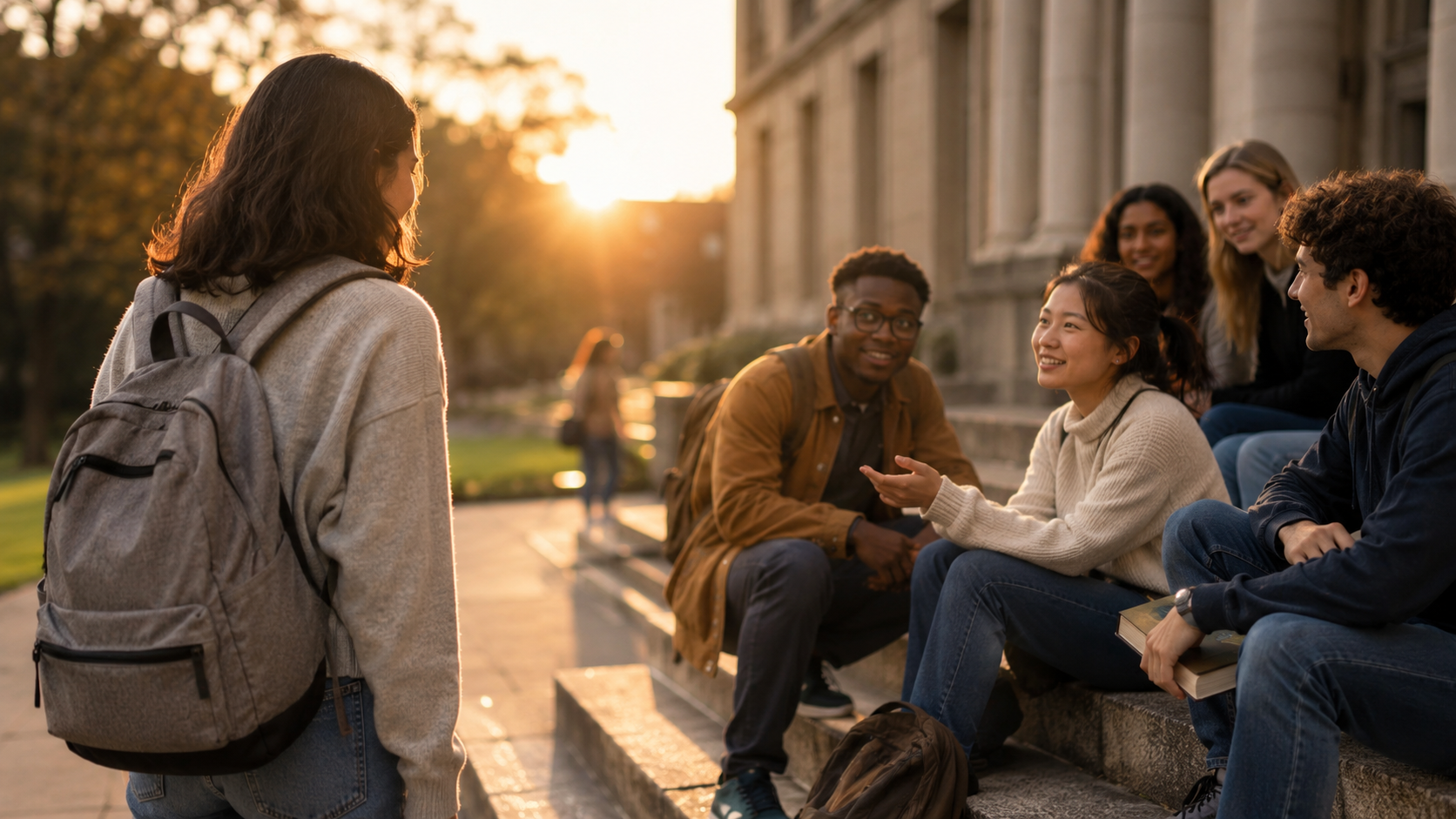
Seeking for ideas there makes sense. College can be a hard time for young people – and it may be useful model of challenging times generally. Think about what students face.
Leave home, or at least leave old roles. Enter new rooms. Risk rejection. Try on identities. Ask for help. Make friends. Handle failure. Deal with financial pressures. Sit with loneliness. Walk into a club meeting where everyone already seems to know each other. Speak in a seminar while your heart pounds.
We’ve long known that if students can develop a sense of belonging, college is much more likely to be a good experience. Without that sense you can be sitting in a classroom, walking across a campus, or scrolling through posts from people who seem to be having the time of their lives, and feel as if there is a sheet of glass between you and the world. Everyone else seems to know the rules. Everyone else seems to have found their people. Everyone else seems to have gotten the memo.
You are the odd one out. You don’t belong. Even if you aren’t a student doesn’t that sound familiar?
And then the mind starts doing what minds do: “What’s wrong with me?” “They don’t want me here.” “I’m behind.” “I’m too different.”
I’ve spent a lifetime studying how human beings get trapped inside painful thoughts and feelings like that, and how we can learn to carry them differently. A new study of over 16,000 undergraduates at 104 U.S. colleges and universities gives us a useful clue about and least one thing we can do about it.
Students who were higher in psychological flexibility reported much greater sense of belonging. The difference was not tiny. Students in the highest quartile of psychological flexibility were more than a full standard deviation higher in belonging than students in the lowest quartile.
Now, let’s be careful. This was a cross-sectional study. It does not prove that flexibility causes belonging. It may be that belonging helps people become more flexible. It may be both. It may be that other factors are involved.
But the finding is still worth our attention.
Why? Because psychological flexibility is not a personality trait handed down by the gods. It is a learnable set of skills. It means being more open to what you feel, more aware of what is actually happening, and more able to take values-based action, even when your mind is noisy and your emotions are tender.
Before we look at the implications, I want to share a brief, proud personal note.
The data for this research comes from the Healthy Minds Study, an incredible initiative founded at the University of Michigan by Dr. Daniel Eisenberg (who is now at UCLA). Dan is a longtime research collaborator of my wife, Jacqueline Pistorello – an expert in college student mental health. For years, including during her tenure on the national Advisory Board for the Center for Collegiate Mental Health (CCMH), Jacque has been an advocate for measuring psychological flexibility on a national scale and she is part of why measures of this skillset finally made it into the nationally distributed Healthy Mind survey set. Seeing this measure now being used to understand a key aspect of student well-being is a beautiful full-circle moment.
Institutions need to build environments where students are respected, included, protected, and seen. A student cannot “flex” their way into belonging in a hostile or indifferent environment, and we should never use important psychological skills to blame people for exclusion.
But belonging is also not something you wait around to feel before you begin. Belonging is something you practice.
The mistake is to treat belonging as a feeling that must show up first: “When I feel confident, I’ll go.” “When I feel accepted, I’ll speak.” “When I stop feeling awkward, I’ll reach out.”
That is the trap.
Life often works the other way around. You take a small step toward connection while awkwardness is still in the room. You say hello while your mind predicts rejection. You send the text while feeling vulnerable. You show up to the group before you know whether you fit. You ask the question while the old “not good enough” story is muttering in the background.
This is not positive thinking. It is not pretending everything is fine. It is psychological flexibility applied to one of the deepest human yearnings: the yearning to belong.
Try this.
Bring to mind a place where you would like to belong more fully. It might be a classroom, a workplace, a neighborhood, a family, a faith community, a professional group, or even a friendship you have let drift.
Now notice what shows up inside. Maybe there is fear. Maybe there is shame. Maybe there is resentment. Maybe there is sadness. Maybe there is a thought like, “I shouldn’t have to be the one to reach out,” or “They won’t care,” or “I’m too much,” or “I’m not enough.”
That is your mind trying to protect you. Thank it for the effort then ask a different question: “What if belonging is a verb?”
Not belonging as a warm feeling. Not belonging as proof that others approve of you. Belonging as behavior.
Would it look like introducing yourself to one person? Staying five minutes longer after class? Asking someone to coffee? Joining one activity that matters to you? Telling the truth a little more kindly? Listening more fully? Apologizing? Setting a boundary? Letting someone know you are lonely instead of pretending you are above it all?
Your feelings are not barriers to belonging. They are part of the path. Anxiety may be telling you that connection matters. Sadness may be telling you that you miss being seen. Shame may be pointing to an old wound that needs kindness. Even the thought “I don’t fit” may be an echo from previous experiences, not a prophecy about the next one.
For educators, parents, counselors, and campus leaders, the implication is just as practical. Don’t just tell students, “You belong here.” Make it true. Build classrooms and communities where students are known by name, where uncertainty is normalized, where help-seeking is respected, where cultural histories are honored, and where participation has many doors.
Then teach the skills that help students walk through those doors.
A campus of belonging needs both sides. It needs places that are worthy of trust, and people who are supported in the hard work of entering them.
That is the deeper message of this massive new study. Psychological flexibility may help students stay in the room long enough for the room to become theirs.
So today, ask yourself: Where am I waiting to feel like I belong before I begin? And what is one tiny act of belonging I could do now?
Then send the text. Ask the question. Join the group. Say hello. Tell the truth. Make the invitation. Sit with the awkwardness. Let your heart come with you.
Belonging is not only a place you find – It’s a life you build, one flexible step at a time.
Reference
Dearth-Wesley, T., Herman, A. N., & Whitaker, R. C. (2026). The association between psychological flexibility and sense of belonging among US undergraduate students. Innovative Higher Education, 1-21. DOI: 10.1007/s10755-026-09887-4